
Calling community historians: medieval Wytham belongs to YOU!
Would you like to know more about your local area? Are you curious about medieval history but don’t know where to start your research?
If so, you are in the right place. This is a short introduction to some of the materials available to aspiring medieval historians and which you may encounter when undertaking your research. It also offers some help about how you can use them. The examples we have chosen are based on Wytham in medieval Berkshire, now part of Oxfordshire. The approach and types of document (called ‘primary sources’) can be found for many other parts of England too. And the general research methods should be useful for any community history project, be it a survey or a more in-depth analysis. Community history can include studies of places of worship, land ownership and use, trade and commerce, the role of women – the list goes on!
This introduction focusses largely on readily available sources. They can be accessed in a variety of ways. Six different Wytham-related sources have been chosen as examples of the sorts of information you may find, and in what kind of place. Section 7 provides further information to assist you to meet your project objectives. As you will see, there is plenty of information to help you.
The starting point for any historian is to gain an understanding of relevant ‘primary sources’ and ‘secondary sources’. Primary sources are documents or physical items which were produced at the time that you are investigating. Secondary sources are books or shorter pieces published in journals or on websites written by historians later on – perhaps this is what you are aiming to do!
A good place to start is with publicly available information, whether online or in a local library. It is important to use books written by trusted experts, particularly as you start your research. One example is the Victoria County History (VCH) series. The VCH project was founded in 1899 and is still proudly producing new research. Its aim is to publish a detailed history of every county in England. A great deal of its work can be accessed online courtesy of British History Online which also holds a wealth of other primary and secondary source material: Front | British History Online. As well as providing overall histories of each county (such as on geology, farming, industry, local infrastructure, and religious houses) the VCH aims to produce histories of every individual parish.
Although medieval parishes were not the units of local government that they later became, the basic parish structure that we know today was essentially in place by the twelfth century. The Wytham entry can be found here: Parishes: Wytham | British History Online. Check out the footnotes as well as the text! These can point you in the direction of primary source materials which you may wish to explore further. There is plenty more publicly available information just waiting to be found and analysed depending on your particular interest.
Once you have an overview of your medieval place of interest, how do you find primary sources and get your research underway? The UK National Archives (TNA) at Kew in London has a wealth of records – millions in fact! At the time of writing their website states that they take up 185 kilometres of shelving! Most documents are administrative in nature, having been created or collected for the government from the eleventh to the twentieth centuries. Medieval royal governments, certainly from the twelfth century, were remarkably copious and systematic in the making and keeping of records. The result: a treasure trove for historians!
To help you get started, TNA have produced 360 research guides covering a wide variety of topics and records: Research guides - The National Archives. Not all the guides relate to the medieval period but many do. When you come to look for actual records, the TNA search engine, called Discovery, is easy to use and can be found here: Discovery | The National Archives. This enables you to look for documents in archives all over the country – not just those in TNA. It will also tell you if a document can be downloaded from the website.
Most documents cannot be accessed in this way and you will need to visit the the archive in person to consult them - whether at Kew or in other local archives across England. Sometimes you may be able to ask for a scan of the item for a small fee. A trip to consult a real medieval manuscript, though, is an incredibly exciting experience! There is nothing like seeing and holding a medieval document in your hand (carefully)! But this is not practicable for everyone. An alternative method is provided, for some legal and administrative documents, by looking at the photographs of some categories of legal and administrative documents on the Anglo-American Legal Tradition website hosted by the University of Houston : AALT Home Page. It does not contain all available sources but it is very useful, especially if you live further afield.
There are some sources written in English, such as the rent roll discussed below, but most of the documents which have survived were written in Latin or medieval French. Latin was the language used to record most legal, financial, and other administrative business, and French was the language of polite society until the later fourteenth century. Most surviving documents are, in fact, of an administrative nature. It is unlikely that you will find diaries – and certainly not newspapers or novels! After all, most people could not read or write (their memories were good, though). But do not be discouraged: with a little intrepid research you will be able to start to build a picture to answer your research questions.
For most people, Latin is a challenge. Nevertheless, many of the sources, such as the ‘foot of fine’ below, were created in large numbers and it is possible to learn how to decipher them. TNA has a free Latin course Learn medieval Latin - Latin which may help you. If you are lucky, there may also be local Latin classes offered in your area. Regardless of the language used, be prepared to encounter challenges along the way. Some of these are fun, and all part of the detective work of being an historian. The Wytham search, for example, needed to take into consideration the various spellings used (e.g. Wightham), the fact that there are other places in England with the same name, and that it is also used as a surname. Another thing to bear in mind is that the currency used is not the decimal system that we are familiar with today – in medieval documents, money was usually calculated in pounds, shillings, and pence. There were twelve pence to the shilling and twenty shillings to the pound. A very interesting question is how much you could buy with your medieval shilling, and how much that shilling is worth now – have a look at TNA’s currency converter, here: https://www.nationalarchives.gov.uk/currency-converter/
There are also many helpful books such as Eileen Gooder’s Latin for Local History: An Introduction (Routledge, 2nd edition, 2013) which can be found in all good book shops. Second-hand copies of earlier versions are also available at the time of writing, or it can be accessed at the Oxfordshire History Centre https://www.oxfordshire.gov.uk/residents/museums-and-history/oxfordshire... or Oxfordshire libraries.
The Oxfordshire History Centre also holds a number of medieval deeds, court rolls, royal enquiries, parish, and borough records. To search for your community’s medieval records follow this Heritage Gateway link: Heritage Search - Oxfordshire County Council. And remember, it may not be vital to read every word in the document! You can decipher names, for example, relatively easily – and names can be informative! Field names tell us about land use and landscape features; last names can tell us about occupations and origins (including those of women); witness lists can tell a story of their own about social connections in the vicinity.
Another top tip is to look at the calendars (summaries) of many government documents which have been published in English and are widely available, particularly on the British History Online site.
Of course, all primary sources need to be interrogated carefully before you draw any conclusions from the evidence they contain. Who wrote it? Why? Is it a draft or the final version? Could it even be a forgery? At the end of this article is a handy list of questions which you might want to ask of a document as you assess its usefulness. You’ll probably think of more questions for yourself!
For this introduction to medieval Wytham, six main primary sources were chosen for illustrative purposes: a charter, a cartulary, a foot of fine, a letter patent, a lay subsidy return, and a rental. These terms may sound strange to you, but we’ve explained their meanings in turn below. We chose them as a good starting point for a range of investigations. Every document will appeal to different readers in different ways, depending on their interests, but our examples here contain fascinating evidence about property and wealth, agricultural activities, social relationships, the legal system, and people’s sense of place. Your own ideas about how you might use the evidence will spring to mind as you read the documents, but think too about what the possible drawbacks might be…
And now – read on!
1. Charter transferring property in Wytham: Bodleian Library, Special Collections, MS Berks Ch 248
2. Godstow Cartularies – E 164/20, 1404, TNA, London and Rawlinson MS B 408, Oxford University, Bodleian Library, Special Collection
3. Foot of Fine – Court of Common Pleas, 1298 (document reference TNA CP 25/1/9/36).
4. Letter Patent, 1302 (Reference: TNA C66/122 Membrane 19)
5. Lay Subsidy, 1334 (Reference: TNA E179/73/9)
6. Rent Roll – MS. Rolls Berks. 12, 1491/2, Oxford University, Bodleian Library, Special Collections
7. Other Primary Sources and Assistance
a) Domesday Book - E 31/2/1/1700, 1086, TNA, London
b) Taxatio Database
c) Gazetteer of Markets and Fairs
d) Oxfordshire Record Society
e) Oxfordshire Architectural and Historical Society (OAHS)
f) Further Studies
8. Summary
1. Charter transferring property in Wytham: Bodleian Library, Special Collections, MS Berks Ch 248
To begin, we have chosen a charter – that is, a formal deed making a grant. Charters were used to record gifts (or sales) of land, rents, or privileges. Many charters have survived from the medieval period, particularly from the thirteenth century onwards as it became more usual for people to make and keep records of property transfer. Such documents are valuable for historians and not just because they show us who owned what, where, and when. They give us vital evidence about the ways in which it was possible to hold property, including the payments and services that were due, and to whom, and who the heirs to the property were to be. They can tell us about land use, patterns of settlement, and even the social connections of the people involved.
Read the charter translated below which records that Geoffrey de Kypenham has transferred half an acre of arable land in Wytham to Richard Ingald. There is a lot of what we might now call ‘small print’ such as Geoffrey’s guaranteeing Richard’s right to the property against all comers. This is not surprising – we’d expect that today. But setting the legal phraseology aside for the moment, what do you make of the charter?
Know, persons present and future, that I, Geoffrey de Kypenham of Wytham, have granted, given and by this my present charter have confirmed to Richard Ingald of the same, in return for his homage and service and for eleven shillings and six pence of silver which he has given to me in advance in cash, one half-acre of my arable land lying in the village of Wytham in the field which is called Lemarschalestuft between the wood of Edward Le Kying on one side and bordering a headland on the road called Slitweie and on the other headland on the land of Walter Stanilond […] more or less. To have and to hold from me and my heirs and my assigns to him and his heirs and whomsoever his assigns, to whomsoever or whensoever he wishes to give, bequeath, sell, or assign the said piece of land with its appurtenances, except for religious houses, freely, quietly, properly, in peace, in fee and inheritance, rendering for this annually to me and my heirs or my assigns three half-pennies, that is, at Christmas. And one half penny to the general aid of the Lord Abbot of St Edmund, when it is imposed by the same abbot, for all services, customs, exactions, aids, suit of court and secular demands. And I, the aforesaid Geoffrey, and my heirs or my assigns shall guarantee, acquit, and in every respect defend the said piece of land with appurtenances to the aforesaid Richard and his heirs or his assigns whomsoever through the aforesaid service against all people in perpetuity. In witness of which thing I have set my seal to this writing. By these witnesses: James de Geddingge, Robert de Belencumbre, William Biscop, Ralph de Belingge, Robert de Scalare, Godwin de Kypeham, William Le Salerne, Simon de Houtune, Thomas Le Futer, and others.
First, it looks as if it is a sale between neighbours. Both Richard and Geoffrey are from Wytham. Richard has made an upfront cash payment of 11s. 6d. to get this piece of land. At a time when a man’s daily wage might have been 3d. this is quite a bit of money, given especially that the annual rent that Richard was to pay Geoffrey was just 1 ½ d. at Christmas! Could Geoffrey have been short of cash? The only other due which Richard is to pay is the half-penny payable as ‘aid’ (a form of tax) to the abbot of St Edmund. This is probably a reference to the abbot of Abingdon who owned most of the land in Wytham at this point. Otherwise, Richard is allowed to bequeath, sell or give the land away to whomsoever he chooses, except ‘men of religion’. Why might Geoffrey not want the property to pass into the hands of a religious house? Certainly, there were concerns in the late thirteenth century about religious houses gaining property because it could mean loss of customary services and dues.
Thinking beyond Geoffrey and Richard, we might make a note of the land use in Wytham to which the charter refers – there is a wood, and the land itself is arable. There are also some local names: ‘Lemarschalestuft’ (the marshal’s ground?) is the field where the land is located and ‘Slitweie’ the road that marks one of its boundaries. Other people mentioned are those whose lands border on the half-acre being transferred. There are witnesses to the transaction, too. If they were neighbours of Geoffrey and Richard then it seems they knew of, and perhaps supported, what was happening.
The charter is undated, but the style of the handwriting enables us to guess that it was probably made in the later thirteenth century.
2. Godstow Cartularies – E 164/20, 1404, TNA, London and Rawlinson MS B 408, Oxford University, Bodleian Library, Special Collection
The charter we have just looked at is preserved as an original. In fact, it is much more common to find medieval deeds in the form of copies. These are often found in what is called a cartulary. Cartularies are copies of documents (charters, deeds, and other material) contained in a manuscript in a similar way to a modern book. They often relate to estates and are associated with religious houses. It was a good way of keeping important documents together. One such cartulary exists for Wytham’s neighbour in Godstow – Godstow Abbey. You can find out more about Godstow Abbey from its entry in the VCH, here: https://www.british-history.ac.uk/vch/oxon/vol2/pp71-75. In fact, and rather intriguingly, there are two in existence. One was written in Latin and one in English. The English version is thought to have been compiled in c. 1450. Both have been published, and both can be viewed at the Oxfordshire History Centre. Two simple searches (Godstow English and Godstow Latin) performed using Oxford University’s Search Oxford Libraries Online (SOLO) system filtered by Oxfordshire History Centre provide the relevant details: SOLO although you will not be able to access the full texts.
The Latin version differs to the English version. The English version contains 16 charters relating to Wytham which were not directly related to Godstow. Why might this be? And why might an English version have been created for the nuns in the fifteenth century? The English register contains over 20 relevant documents for this project, largely grants, from the twelfth to the fifteenth centuries. The documents cover a variety of topics revealing, for example, the presence of mills in nearby Seacourt, gifts from Wytham residents to the abbey, field names, and the names of witnesses. Such snippets have the potential to tell us about local trades, relationships, land use, and, of course, a great deal about the abbess and nuns.
3. Foot of Fine – Court of Common Pleas, 1298 (document reference TNA CP 25/1/9/36).
Despite its rather odd sounding name, a foot of fine (also known as a final concord or agreement) is a conveyancing record. It represents a clever legal device – the outcome of a fictitious dispute whose purpose was to create an official record of a transfer of property. The transaction was recorded three times on the same piece of parchment which was then cut into three parts. The part retained by the government was at the bottom, or the ‘foot’. Only the original three sections would match together in the future and thus prove the transaction was genuine. If you are interested in finding out more about feet of fines have a look at the Research Guide on The National Archives website: https://www.nationalarchives.gov.uk/help-with-your-research/research-guides/land-conveyance-feet-of-fines-1182-1833/
For the intricacies of the medieval legal system more generally, John Baker’s book An Introduction to English Legal History (Oxford University Press, fifth edition, 2019) is a good place to start.
Our Wytham example comes from the central law court, the Court of Common Pleas, in a session of the king’s justices at York in November 1298. You can see the line at the top where the document was cut: AALT Page. The upshot of the case was that William Bleburi gave Philip Wyghtham (or Wytham!) and Agnes his wife a house and 120 acres of land in Wytham as well as the right to nominate the parish priest of Wytham church. As a start, we have provided an English translation of the text. (Literal translations can be quite cumbersome so we have given an informal one.)
This is the final agreement made in the king’s court at York on 18 November 1298 before John Metyngham, William Bereford, Elias Bekingham, Peter Malorre, and William Howard, justices, and others who were there, between Philip Wyghtham and his wife Agnes, transferees, and William Bleburi, transferor, of a house and approximately 120 acres of land in Wytham and associated rights, and the right to nominate the church priest in the same town.
As a result of which a plea of covenant was made between them in the court in which Philip and Agnes agreed that the land and building with associated rights, and the right to nominate the church priest, belonged to William as they gave them to him as a gift. In return for this acknowledgement, payment, and agreement, William has given up his rights in the land and building with associated rights, that is, everything William possessed in the town, and the right to nominate the church priest, without reservation, as of 18 November 1298.
And William returned the plea of covenant to Philip and Agnes in the same court, to have and to hold by Philip and Agnes and their heirs from the chief lords of the area providing the relevant service owed for the land, building, and the right to nominate a priest forever. And if Philip dies without an heir produced by Agnes, then when Philip and Agnes have died, the land and building with associated rights, and the right to nominate the priest will transfer to Philip’s heirs.
To be held of the chief lords of that fief in return for the services which are associated with the land, building, and the right to nominate the church priest, forever.
The more you consider this, the more questions arise. Why did the transfer take place? Who were the individuals involved? How usual was it for women, such as Agnes, to hold property jointly? Was this their only property in Wytham? What happened next? Did they have children? What was William left with? And where exactly was the land?
And if you would like a ‘bridge’ between the English translation and the Latin manuscript we’ve included a transcription of the Latin document. The square brackets indicate missing letters. For example, the Latin word facta was often shortened by scribes to ‘fca’ with a line over the top to indicate that letters are missing. This is shown in the transcript as f[a]c[t]a. Further help with deciphering abbreviated forms can be found in C. T. Martin’s The Record Interpreter: A Collection of Abbreviations, Latin Words and Names used in Historical Manuscripts and Records (Stevens and Sons, 2nd edition, 1910 and reprinted).
Transcript:
Hec est finalis concordia f[a]c[t]a in Cur[ia] d[o]m[ini] Regis apud Ebo[racum] in Octab[is] s[anc]ti Martini Anno Regni Regis Edwardi filii Regis Henrici vicesimo sexto. Coram Joh[ann]e de Metyngham, Will[el]mo de Bereford, Elia de Bekingham, Petro Malorre et Will[el]mo Howard Iustic[iariis] et aliis d[o]m[ini] Regis fidelibus tunc ibi p[re]sentibus.
Int[er] Ph[ilippu]m de Wyghtham et Agn[etem] vx[orem] eius quer[entes] et Will[el]m[um] de Bleburi deforc[iantem] de vno mesuag[io] et vna carucata t[er]re cum p[er]tin[enciis] in Wyghtham et aduocat[i]one Eccl[es]ie eiusdem ville.
Vnde pl[acitu]m conuent[i]onis sum[monitum] fuit int[er] eos in eadem Cur[ia]. Scil[ice]t q[uo]d p[re]d[ict]i Ph[ilipp]us et Agn[es] recogn[overunt] p[re]d[ic]ta ten[ementa] et aduocat[i]o[ne]m p[re]d[ic]tam cum p[er]tin[entiis] esse ius ip[s]ius Will[elm]i.
Vt illa que idem Will[elm]us h[ab]et de dono p[re]d[ic]to[rum] Phi[lippi] et Agn[etis]. Et p[ro] hac recognit[i]one fine et concordia idem Will[elm]us concessit p[re]d[ic]tis Ph[ilipp]o et Agn[eti] p[re]d[ic]ta ten[ementa] et aduocat[i]o[n]em p[re]d[ic]tam cum p[er]tin[entiis] scil[ice]t quicq[ui]d idem Will[elm]us h[ab]uit in p[re]d[ic]t[a] villa vt in d[o]m[ini]co et s[er]uic[i]o sine vllo retenemento die quo hec concordia f[a]c[t]a fuit.
Et illa eidem Ph[ilipp]o et Agn[eti] reddidit in eadem Cur[ia]. Habend[a] et tenend[a] eodem Ph[ilipp]o et Agn[eti] et her[edibus] quos idem Ph[ilipp]us de corp[or]e ip[s]ius Ang[netis] p[ro]creav[er]it de Capit[alibus] d[omi]nis feodi illius p[ro] seruitia que ad illa ten[ementa] et aduocat[i]o[ne]m p[re]d[ic]tam p[er]tinent imp[er]p[etuu]m. Et si contingat q[uo]d p[re]d[ic]tus Ph[ilipp]us obierit sine herede de corp[or]e ip[s]ius Agn[etis] p[ro]creato tunc post decessum ip[s]o[rum] Ph[ilipp]i et Agn[etis] p[re]d[ic]ta ten[ementa] et aduocat[i]o pred[ic]ta cum p[er]tin[entiis] integre remaneb[u]nt Rectis her[edibus] ip[s]ius Ph[ilipp]i.
Tenend[a] de capit[alibus] d[o]m[ini]s feodi illius p[er] seruitia que ad illa ten[ementa] et aduocat[i]onem pred[ic]ta[m] pertinent imp[er]p[etuu]m.
Even without much knowledge of Latin, it is possible to spot the names of the individuals involved and, of course, to see Wytham (Wyghtham) in the text. If you like, you can try to build up your own ‘alphabet’ as you recognise the individual letters. This will help you to recognise the medieval forms of letters in manuscripts in future.
4. Letter Patent, 1302 (Reference: TNA C66/122 Membrane 19)
Letters patent were royal grants and covered both temporary arrangements and grants in perpetuity. They were ‘patent’, or open, in the sense that the seal did not have to be broken to disclose the contents but hung from the parchment to affirm the letter’s authenticity. When the letter was sent, a duplicate was kept centrally, on ‘patent rolls’ which were copies of issued letters. The document selected here relates to a gift of land to an ecclesiastical establishment. After 1279 when the Statute of Mortmain was enacted, such transfers could only be made with royal permission, known as a mortmain license. (Mortmain literally means ‘dead hand’ – because property owned by the Church did not involve feudal services or dues when the holder died. (Remember the clause in the Wytham charter, above?) This is certainly a complicated topic! If you would like to know more about how the licensing system worked, start with Sandra Raban’s book Mortmain Legislation and the English Church, 1279-1500 (Cambridge University Press, 1982).
Our example document again concerns Wytham’s neighbours at Godstow Abbey: AALT Page. (It is in the middle of the photograph of membrane 19 of the roll for 1301-2. See how the medieval index worked – by using marginal notes to identify each fresh entry. In this case, look for ‘P[ro] Abbatissa de Godestowe’.)
The details of the licence reveal that the abbess had paid for the licence to enable John de Pratellis (John Littlemeadows?) to grant the abbess and nuns two acres of land in nearby Great Tew and the advowson of its church (remember the Wytham example - simply put, it was the right to nominate a priest). He also granted rent to the value of 2 shillings in the same village which was paid to him by Stephen de Pratellis (Stephen Littlemeadows!) for two virgates of land (approximately 60 acres). Two shillings is 10 pence in modern money, but it was worth a lot more than that in 1302! Have another look at TNA’s currency converter referenced above in the section on the Wytham charter. You might also check out the Bank of England’s inflation calculator to see how prices have changed since the year 1209: https://www.bankofengland.co.uk/monetary-policy/inflation/inflation-calculator
So, again, the document poses lots of questions. Why did John make this grant? What was he getting in return? What was his family connection with Stephen?
If you have enjoyed working with this example of a letter patent, a simple place name search reveals that there are at least ten letters patent which relate to Wytham. These should help you to build up a sense of the people who were part of the local community and how they interacted with one another and with their neighbours.
A transcript and translation of this document are given below. . A summary in English can also be found in the calendar of letters patent, page 44, available online: Calendar of the patent rolls preserved in the Public Record Office. Edward II : Great Britain. Public Record Office : Free Download, Borrow, and Streaming : Internet Archive.
How would you compare medieval legal documents to legal documents you come across today? Has this document changed your view of medieval society?
Link to document: AALT Page
Transcript
Rex om[ni]bus ad quos et c[etera] sal[u]t[e]m. Licet de co[mmun]i consilo regni nostri statu[er]imus q[uo]d non liceat viris religiosis seu aliis ingredi feodu[m] alicuius, ita q[uo]d ad manu[m] mortuam deveniat sine licencia n[ost]ra et capitalis d[o]m[ini] de quo res illa immediate tenet[ur].
Nos tamen p[er] finem quem dil[e]c[t]a nob[is] in Christo. Abbatissa de Godestowe fecit nobiscu[m] coram ven[er]abili p[at]re Walt[er]o [expunged script] Couentr[iensis] et Lych[efeldensis] Ep[iscop]o Thes[aurario] n[ost]ro concessimus et licentiam dedimus qu[an]tum in nobis est Joh[ann]i de Pratellis q[uo]d ip[s]e duas acras t[er]re cum p[er]tin[entiis] in magna Tue vna cum advocatione eccl[es]ie eiusdem ville dare possit et assig[nar]e p[re]fato Abbatisse et monialib[u]s eiusdem loci. H[ab]end[a] et tenend[a] eisdem Abbatisse et monialib[us] et ea[rum] successorib[u]s de capitalib[u]s d[o]m[inu]s feodi illius p[er] s[er]uitia inde debita et consueta imp[er]petuu[m].
Concessim[us] etia[m] eide[m] Joh[ann]i q[uo]d ip[s]e similit[er] dare possit et assignare eisdem Abbatisse et monialib[us] duas solidatas redditus quas idem Joh[ann]es p[er]cepit a Steph[an]o de Pratellis singulis annis ad t[er]minu[m] vite i[p]sius Steph[an]i p[ro] duab[us] virgatis t[er]re quas idem Steph[ani]s tene[t] de eodem Joh[ann]e in eadem villa ad t[er]minu[m] vite ip[s]ius Steph[an]i p[er]cipend[um] et h[ab]end[um] p[er] manus eiusdem Steph[an]i [quam]diu vix[er]it.
Concessim[us] insup[er] p[re]fato Joh[ann]i q[uo]d ip[s]e concedere possit p[re]fatis Abbatisse et monialib[us] d[ic]tas duas virgatas t[er]re cum p[er]tin[enciis] h[ab]end[as] et tenend[as] post mortem p[re]d[ic]ti Steph[an]i eisdem Abbatisse et monialib[us] et ea[rum] successorib[us] de capitalis d[o]m[ini]s feodi illi[u]s p[er] s[er]uitia inde debita et consueta imp[er]petuum et eisdem Abbatisse et monialib[us] q[uod] i[p]se t[er]ram aduocat[i]o[n]em et redditum p[re]d[ic]tos a p[re]fato Joh[ann]e recip[er]e possint et ten[er]e sibi et successoribus suis p[re]d[ic]tis sicut p[re]d[ic]t[u]m est tenore present[iu][m] similit[er] licentiam dedim[us] sp[eci]alem.
Nolentes q[uo]d idem Joh[ann]es aut heredes sui seu p[re]dicte Abbatissa et moniales vel successores sue ratione statuti p[re]d[ic]ti p[er] nos vel heredes n[ost]ros iustic[iarios] vic[ecomites] aut alios ministros n[os]tros quoscu[m][que] inde occ[asi]onentur molestent[ur] in aliquo vel g[ra]vent[ur].
In cuius et c[etera] T[este] R[ege] ap[u]d Westm[onasterium] xx die Iul[ii]
Translation
The king to everyone, to whom etc., greetings. Although we have decreed by the common counsel of our kingdom that it is not lawful for religious men or others to enter the fief of anyone such that it may come to mortmain without our licence and the chief lord of whom it is immediately held, we, however, for the fine which the abbess of Godstow, beloved by us in Christ, made with us before the venerable father Walter, bishop of Coventry and Lichfield, our treasurer, have granted and given licence, as much as is in us, to John de Pratellis that he may be able to give and assign two acres of land with appurtenances in Great Tew with the advowson of the church of the same vill to the aforesaid abbess and nuns of the same location. To be had and to be held to the same Abbess and nuns and their successors from the chief lords of that fee by the services thereupon due and accustomed in perpetuity.
We have also granted to the same John that similarly he himself may give and assign to the same abbess and nuns two shillings of rent per annum which the same John secured from Stephen de Pratellis until the end of the life of the same Stephen for two virgates of land which the same Stephen holds from the same John in the same vill until the end of the life of the same Stephen, to be secured and to be held by the hand of the same Stephen himself for as long as he himself shall live.
We have granted, in addition, to the aforementioned John that he himself may relinquish to the aforementioned Abbess and nuns, the said two virgates of land with appurtenances, to be had and to be held after the death of the aforementioned Stephen by the same abbess and nuns and their successors from the chief lords of that fee by the services thereupon due and accustomed in perpetuity and by the same abbess and nuns that they may receive the aforementioned land, advowson, and rent from the aforementioned John and hold to him and his successors aforementioned, as aforesaid we have given similarly a special license to the tenor of the present circumstance.
Not wishing that the same John or his heirs or the aforesaid abbess and nuns or their successors by reason of the aforementioned statute may be accused, molested, or harmed in any way by us or our heirs, our justices, sheriffs or any other of our ministers whatsoever. In [witness] of which, etc. Witnessed by the king at Westminster on the 20th day of July.
5. Lay Subsidy, 1334 (Reference: TNA E179/73/9)
A lay subsidy was a form of direct taxation payable to the Crown, granted by Parliament and usually to fund exceptional royal expenditure – in this case, war with Scotland. Prior to 1334, the calculation was based on the personal wealth of the laity only, thus excluding the wealth of the church which was taxed separately. The lay subsidy was payable on moveable assets such as crops and stock rather than fixed assets such as land and buildings. The percentage charge varied year on year. In 1334, it was charged at a fifteenth for rural areas and a tenth for boroughs and ancient demesne (usually royal manors listed in the Domesday Book – see Section 5 below for more on this source). However, as is often the case with medieval affairs, it is unclear as to what constituted a borough. Some larger towns, such as London, managed to escape the higher charge. More detailed information and a transcript of the source can be found in R. Glasscock (ed.), The Lay Subsidy of 1334 (Oxford University Press/British Academy, 1975).
Because of corrupt practices in previous years, the collection method for the 1334 assessment changed and the names of individuals were no longer recorded. The National Archives | E179 | Document notes provides more information. Can you think of ways in which the assessments might have been manipulated for personal gain? One example could be hiding assets from assessors in order to reduce the tax charge. Despite not having the individual assessments included on the returns, the information is still useful. For example, Wytham was in the administrative unit named Hormer Hundred (a hundred, not a parish, being the grouping method used at this time). The document shows, for example, that Wytham was assessed at £3 16s. 5d. In comparison, Seacourt (Seukworth’) was assessed at £1 6s 9.5d and Abingdon (Abyndon’) at £17 18s. 7 ½ d. To put the figures into context, the Bank of England inflation calculator: Inflation calculator | Bank of England (adjusted for shillings and pence) provides a modern-day (January 2025) total of £4,079.81 for Wytham.
In some areas, it is possible to compare this subsidy to the poll taxes of 1377, 1379, and 1381. This gives a pre- and post-Black Death picture. These taxes have been published and the relevant book for Wytham is C. C. Fenwick (ed.), The Poll Taxes of 1377, 1379 and 1381, Part One, Bedfordshire-Lincolnshire (Oxford University Press/British Academy, 1998). Unfortunately, very little information has survived for the Wytham area. But there are other places nearby with more evidence. For example, in nearby Faringdon, we can see that Richard de Dence and his wife Maria were assessed at 3s., whereas William Taillour and his wife Margaret were only assessed at 2s. Why do you think this difference in assessment rate arose? It is also interesting to note that wives were recorded and taxed. There are 36 results (assessments) in this category for Wytham between the years 1100 and 1500 which could yield further relevant information.
6. Rent Roll – MS. Rolls Berks. 12, 1491/2, Oxford University, Bodleian Library, Special Collections
The last of our documents is a late fifteenth-century rent roll for Wytham. In fact, there is a lot more here than just a list of rents!
Click the images below to enlarge them!


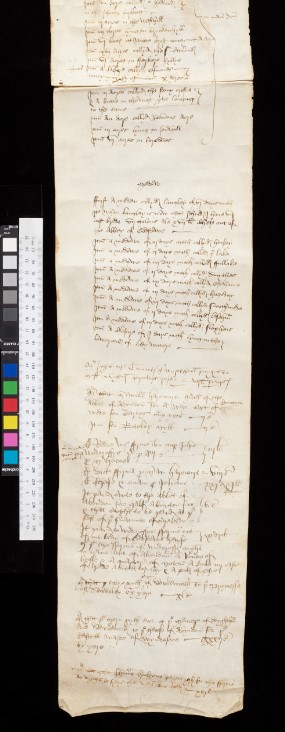


Reproduced by permission of The Bodleian Libraries, University of Oxford.
The roll is written on the front and back of three parchment ‘membranes’, sewn together from top to bottom. The front side is usually referred to as ‘recto’ and the back as ‘dorso’. There are headings – the main heading recording when and where the rental was made and sub-headings too, enabling the different types of revenue that the estate was expected to bring in to be grouped together. You may also see, if you look carefully, that there is more than one handwriting style and that there is additional material in the margins. It is a working document, with additional information and notes of changes over time. The additional material must have been written before the religious reforms of the 1530s, when the religious houses mentioned in the document were dissolved.
And – the document is written in medieval English! We hope that you will take some time to decipher parts of the document for yourself, and that the transcript below, in modern spelling, will help you to navigate the fifteenth-century script.
The marginal notes have been reproduced in round brackets, like this: (). Explanatory material not in the original, such as dates and explanations of unfamiliar words and phrases, is given in square brackets and in italics, like this: [3 February 1492]. We have retained the original spellings of local place names, names of religious houses, and people’s last names.
You might want to read the rental a few times, but if you can get your bearings within it, here are some suggestions for using the document to draw a picture of life in Wytham at the end of the fifteenth century.
What kind of land is there, and how is it being used? What kind of work were people engaged in? What other natural resources might be there? If each named tenant is the head of a household, can you work out how many households there may have been? What are the forms of transport? What connections are there with those beyond Wytham? What kind of changes in land holding and prosperity might be suggested by the later additions to the text?
Wyghtham
A rental newly made there the 3rd day of February the 7th year of King Herry the 7th [3 February 1492].
First, there is a manor with a garden and an orchard that yields by year [No sum of money is given].
Item, a croft called Longcroft that was wont to yield by year 20s.
Item, four yards of arable land in the common field pertaining to the said manor and yields by year 28s. [A yardland was a unit of land; its actual size depended on the locality.]
Item, another croft called Shorte Croft and yields by year 10s.
Item, a parcel of meadow called Fullake, Horsey, and Langley bearing 30 loads of hay and is worth by year 40s.
Item, another meadow called Temlondis bearing by estimation 10 loads and yields by year 8s.
Item, another meadow called Fullake bearing six loads hay yielding by year 10s.
Item, another meadow called Smythes bearing three loads hay and yields by year 3s. 4d.
Item, another meadow called Esterham bearing 17 loads of hay and yields by year 23s. 8d.
Item, four acres of meadow called Northmede and yields by year 10s.
Item, a meadow called Lye and is worth by year 46s. 8d.
Item, a meadow called Cley and is worth by year 26s. 8d.
Item, a croft called the Shephowse close and yields by year 15s.
Item, pasture, 20s.
Item, a meadow called Osmondis, 8s.
Item, two meadows called Ouerpastoke and Netherpastoke yielding by year £4,13s. 4d.
Item, underwood for fuel.
Sum [The total sum is not given.]
Holders at the will of the lord. [Holders without formal title]
(Now in the tenure of William House). John Symond holds one messuage [a dwelling house] with one yardland and yields by year 20s. (3s. 4d.)
(In the tenure of Thom Whith’?). Thomas Howse holds one messuage with two yardlands and yields by year 21s. 8d.
(Andrew Ferthing’) William Zele holds one cottage with a croft and yields by year 4s.
(Richard White and Cheyne). Item, there be two cottages in William Kokyll’ and Folys hands and yield 6s. 8d.
Item, there is a cottage in John Fermour the younger’s hands and yields 3s. 4d.
John Fulford holds one messuage and yields by year 8s.
The same John holds half a yardland 7s.
(Robert Sharpe). William Mylner holds one messuage and one yard
[membrane 2, recto]
land and yields 12s. (and a day’s carting).
William Howse holds one messuage and one yardland and yields by year 16s (and a day’s carting).
(John Brown) John Fermour the elder holds one cottage and 3 acres of land yielding 6s. 8d.
(?Fruin) Robert Daws holds one messuage and half a yardland and yields by year 8s.
(Lost by exchange of Skaulby) John, the abbot of Abingdon, holds one parcel of meadow called Lady Hame [a piece of land] with a way 40 foot broad, the which way belongs to the manor of Wyghtham for 16 oxen there lesyng [pasturing], 13s. 4d.
(Now in the lord’s hand) Thomas Howse holds a hame of Yelsters yielding by year 5s.
(William House) Item, the same Thomas another hame called Secowrte, 5s.
Item, the same Thomas a water for to fish in, yielding by year 13s. 4d.
(Now in the lord’s hand) One close called Flaxheyse with one meadow, yielding by year 13s. 4d.
(Now in the lord’s hand) One meadow called Hacodaye and yields by year 8s.
(Now in decay and in the tenure of Richard H.) Two cottages called Conyng[es] yielding by year 6s. 8d.
(Now in the lord’s hand) One close called Galmous yielding by year 3s. 4d.
(W. House) Thomas Howse holds one yard arable land called Stokys yielding by year 9s.
John Fulford holds one yardland called Paynters yielding by year 10s.
The abbot of Eynesham holds one messuage and half a yardland by knight’s service and owes suit to court [he must attend the manorial court], 7½ d.
(Richard Harecourt) John Horne, squire, holds one messuage with two yardlands with the appurtenances and suit to court 8s.
Item, the same John holds one messuage and one yardland with three quarters of land, 19s. ½ d. (A pound cumin.)
Item, of the abbot of Eynsam for his chief rent 7½d.
Sum [the total is not given]
The demesne lands of Wygtham
First, an enclosure called Dunsted containing 10 ½ acres in the same belonging to bolters[?], over which stands the hedgerow.
Item, an acre called the myll acre. [These first two entries are bracketed together].
Item, an acre called the Smoke acre.
Item, three half acres lying in the Rede lond.
Item, two acres callyd Myxhyllys.
Item, an acre called Gravell Pyttes.
Item, half an acre lying by Ester Hame.
Item, two acres in the short furlong.
Item, an acre called a hadlond in the short furlong.
Item, three acres in the Westhill.
Item, four acres lying in Bryckenhyll
Item, six bottes at Watte Croft containing half an acre.
Item, 16 acres called the Newlond.
Item, six acres in Ferber hyllys.
(Marginal note – [perhaps a person’s name but it is not clear]). Item, an enclosure called Osmondis containing by estimation ten acres.
[membrane 3, recto]
Item, three acres called the Stony crofte and a butt[e] in the west part belonging to the same.
Item, an acre called Ravens acre.
Item, three acres lying in Sondhill.
Item, six acres in Borewes.
[The entries from the Smoke acre to the Borewes are bracketed together with a note: in the lord’s hand, meaning that they were untenanted].
Meadow
First, a meadow called Langley of six days’ math [mowing].
Item, whan Langley is mown then should I have seven ‘cast’ bread, seven gallons ale and seven pounds of cheese out of the abbey of Godstowe.
Item, a meadow of three days’ math called Horsey.
Item, a meadow of two days’ math called the Lake.
Item, a meadow of four days’ math called Fullake.
Item, a meadow of two days’ math called Smythes.
Item, a meadow of nine days’ math called Esterhame.
Item, a meadow of two days’ math called Leseham.
Item, a meadow of three days’ math called Floxheis.
Item, an enclosure of one day’s math lying in the lower end of Lady Water.
Memorandum that the tenants of Wygtt]ham’ pay to Master William Harcowrt yearly £7, 6s.
Memorandum that Master William Harecourt has of the abbot of Abyndon for a way out of Comenor wood for carts every year 2s.
Item, for Boteley mill, 2s.
(Now in Richard Harecourt’s hand) Rent of one farm there lately of John Woderoffys rendered per year for Master Horne, £3.
The said farm for Master W. Harecourt, 8s.
Chief and for John Jelyaus 21d. and one pound of cumin.
Item, paid out to the abbot of Abendon for half a knight’s fee and that ought to be paid at the feast of the Nativity of Our Lady [8 September], 5s.
Item, paid to Woderoffys farm out of my lady of Godstow’s house, 9½ d.
Memorandum that the farmer of Woderoffis ought to have out of Abendon a Ronde [cut] of beef and a quarter of mutton, a Docke, four cast[e] [loaves] of bread, a botell of hay and a peck of oats. [A botell was a measure of quantity for hay and a peck a measure of capacity for grain, normally equivalent to two gallons.]
Memorandum that there goes out of Sewkeworth to the prioress of Sowdeley by year 40s.
Memorandum that there goes out of the manor of Wyghtham and Sewkeworh to the house of Abyndon for the castle ward of Wyndesore by year 32s.
Memorandum that Thom[a]s Hochyns pays yearly for the farm at Wygtham besides that which William Lane holds £16.
[membrane 1 dorse is blank]
[membrane 2 dorse]
[The entries on this membrane have a marginal letter with flourish, possibly an ‘n’]
Memorandum that Robert, lord of Sewkeworth gave to the house of Stodeley the church of Sewkeworth with all the tithes in meadows and pastures and above that one acre of land in Sewkeworth that is called a forschoter[?] of his demesnes and the pasture of three beasts in his demesne pastures with his beasts wheresoever they go.
Item, Robert, bishop of Salisbury confirmed all the gifts that [were] given to the house of Stodeley by Richard, predecessor of the said Robert, bishop of Salisbury.
Item, William of Sewkeworth, son and heir of Robert Sewkeworth, gave to the house of Stodeley three acres of his meadow whereof two acres lie in the South mede which John, the son of Humfrey, held and one acre that the wife of William Trewe held in the said meadow and also the pasture of four oxen and one bull with his beasts in all places wheresoever they go.
Item, the said William, lord of Sewkeworth, gave to the house of Stodeley one messuage, half a yardland with the meadow thereto belonging and the pasture of four oxen going in his woods and meadow with his oxen wheresoever they go.
Item, the same William gave to the church of Sewkeworth in the name of tithes of his demesne meadows one meadow containing five acres and that hey [hedge or enclosure] that lies between the meadow of the church and the water of Temmes.
Item, Denise, the daughter of the said William gave to the house of Stodeley one messuage with a croft and half a yard land and meadow therto belonging and two acres of arable land which lie against Pastoke of one part of the highway that is called Enesham Way.
Item, William, the son of Henry lord of Sewkeworth gave to the house of Stodeley with his body [that is, his body was buried at Studley priory] a yardland in Sewkeworth with the appurtenances, that is to say a croft called Credyens crofte.
Item, Robert, son of Symon Boteley gave to the house of Stodeley a yardland in Sewkeworth.
Item, William of Sewkeworth, son and heir of Sir William, knight, lord of Sewkeworth, gave to the house of Stodeley all lands, rents, possessions the which the prioress and mynchyns [nuns] hold of the gift of the said William his father and all the church of Sewkeworth and for all the aforesaid gifts above rehearsed William Harecourt, lord of Wygtham and Sewkeworth, pays yearly to the aforesaid house of Stodeley 40s.
[membrane 3 dorso]
Ward of Wynsor’
From William Harecourt, squire, lord of Sewkeworth for one knight’s fee there 16s.
From the same, for one knight’s fee in Wygtham lately of Richard Wyghtham 20s.
And that the lord of the manor place of Wygtham ought for to have of the house of Abyndon for the way out of Comenour wood upon my ground 2s. by year, and for the stream to Botley mill, 2s. by year.
7. Other Primary Sources and Assistance
In addition to the six sources looked at here, there are many other possible lines of inquiry and sources to investigate.
|
Domesday Book - E 31/2/1/1700, 1086, TNA, London Would you like to know more about the people living in your area in 1086 and their landholdings? The Domesday survey was commissioned by William the Conqueror, and it is the oldest government record held in TNA. One of its purposes was to assess assets and individuals for tax purposes. It contains over 13,000 places and details the type of land in an area, the landholders, tenants, and other resources. The Wytham entry (or Winteham as it is recorded in this source) can be seen here: Wytham | Domesday Book. It can also be downloaded for free: Place name: Wytham, Berkshire Folio: 58v Great Domesday Book Domesday... | The National Archives. It reveals that there were four villagers and eleven smallholders. It also shows that the immediate lord over the peasants changed from Abingdon Abbey in 1066 to Hubert in 1086. How does this compare to Wytham’s neighbours? And why might this change have taken place? |
|
Taxatio Database This database was constructed over many years and is based on the ecclesiastical tax assessments made in 1291/2 under the authority of Pope Nicholas IV. The underlying tax assessment information, which is now so valuable to historians, was required for tax calculation purposes. Edward I planned a crusade which was to be financed by one-tenth of all ecclesiastical income – hence the need for new accurate figures. The results are extremely useful for community historians. At Wytham, for example, the assessment was £5 13s. 4d. and the church patron (the person who held the right to nominate the next incumbent) was a secular person named John de Blebur. Does this surname sound familiar? It also informs us of the continued connection with Abingdon Abbey which held the benefice of All Saints church: Taxatio. An additional useful piece of information is the grid reference of where the church was located Grid Reference Finder. This is particularly useful in this case as the original medieval church no longer exists (see the VCH for more information). |
|
Gazetteer of Markets and Fairs Gazetteer of Markets and Fairs in England and Wales to 1516. This website has helpfully amalgamated information from a variety of primary sources in order to record details of markets and fairs in England and Wales. It can be searched by county, place, or person. Of course, a grant of a market or fair does not mean that it took place, but repeated entries would suggest that this was likely. Unfortunately Wytham does not appear in the search results, but nearby Godstow does. Godstow had a grant of a fair in the twelfth century which was confirmed in both the thirteenth and fourteenth centuries. It, therefore, seems reasonable to assume that it came to fruition. Based on your knowledge of the surrounding area, why do you think it was held in Godstow? |
|
Oxfordshire Record Society This society was founded in 1919 and publishes a wide variety of written primary sources relating to the county of Oxfordshire. Each year it publishes an annual volume. Publications up to 2017 are available to download free of charge: Publications. For example, the 1958 edition entitled Some Oxfordshire Wills Proved in the Prerogative Court of Canterbury, 1393-1510 contains three entries relating to Godstow Abbey. In the 1488 entry, we learn that Joan Pyper was a nun at the abbey and William Pyper, her father, left her 13s. 4d. (p. 15). The society has also published as a special project An Historical Atlas of Oxfordshire. This book contains maps and short texts by leading local historians covering a wide variety of topics in an accessible way. A similar publication is available for the county of Berkshire and many other counties across England. |
|
Oxfordshire Architectural and Historical Society (OAHS) This society dates back even further to 1839. It publishes the journal Oxoniensia containing articles relating to architecture, archaeology, and history of the city and countryside of Oxfordshire. Volumes from 1936 to 2023 are freely available online: Oxoniensia Volumes. A particularly interesting volume for this project is the 1961/2 publication which contains an article entitled The Deserted Medieval Village of Seacourt, Berkshire. We know from the lay subsidy return that Seacourt was a neighbour of Wytham. This thorough account runs to 143 pages and not only includes information about the excavations which took place but also its written history too. It is a good example of how different types of primary source material can be amalgamated to produce a valuable insight into an area. |
|
Further Studies If you would like to meet like-minded people and gain a more detailed understanding of how to research and write local history, the Department for Continuing Education at the University of Oxford offers a range of courses. A good introductory award-bearing course is the Undergraduate Diploma in English Social and Local History: Undergraduate Diploma in English Social and Local History | Oxford University Department for Continuing Education. |
Summary
This short descriptive catalogue of primary and secondary sources relating to Wytham and some of its neighbouring areas should give you some handy pointers to help you to get your own project underway! We’ve covered the types of documents you may
find, things to bear in mind when reading them, and how to interpret them in order to answer your research questions. We have considered how to search for sources and some of the problems you might encounter in doing so. The sources
we have looked at closely cover a range of topics including land use and ownership, taxation methods, potential local trades, interactions with local religious houses, and connections with nearby towns and villages. There are many more sources
available for Wytham alone. The types of sources discussed here, although they may seem narrow on the surface, have the potential, when taken together, to help you paint a picture of your area in the medieval period.
Medieval history can seem daunting. There are unusual terms and different legal systems to contend with and you have to handle your sources carefully. But there is plenty of help available, and now that you know where to look we hope
that you enjoy the research experience and sharing your findings as much as we do!
Good luck!
Checklist : Questions to ask of Primary Sources
Contemporary interventions
Is this a copy or even a forgery? If so, are there parts missing (for example, lists of witnesses or dates)? Is this document a summary of a much more detailed version? Who wrote it and what was their relationship to the contents? Are there later additions, marginal glosses, or notes? Does the writer acknowledge any sources?
Editorial interventions
Is the document in translation? Is it a calendar or abstract? If in the original language, how has the editor intervened in terms of extension of abbreviations, insertion of punctuation and capital letters? Is there an editorial preface? What is the date of the edition? Are there any obvious errors?
Physical appearance and survival of the record
How does the document relate to the wider collection – is it part of a volume (and if so how has it been placed in relation to the others)? Are there alternative versions (for example, exchequer copies of chancery inquisitions post mortem)? Is the document damaged/illegible/partial in nature? What materials were used to create it? Why is it in the record repository?
Reading the document
Are there any words that you do not understand? These may be technical or arcane terms; or they may survive with different meanings – such as court, family, fine, mercy. Are there entries in the document which do not make sense as they stand – because they refer to events or people without explaining them? How might you fill in the gaps in understanding?
Interpreting the document
What is its purpose? For whom was it made? Is it private, public, formal, informal, legal, or descriptive? To whom was it addressed, if anyone? Who stood to benefit? How accurate might be the maker’s testimony? How reliable is the document as historical evidence? And it is worth noting that liability and accuracy are not necessarily the same. What does the document not tell us?
Is this document one of many, or is it unique of its kind? How might we explore these issues further to discover whether the message here is of wider application? For example, you could consider other documents of the same kind; later/earlier documents in the same series; different documents emanating from the same or neighbouring locality, institution, or written by the same individual; works by historians on the issues suggested by the document; or editions of similar records.
What is the relationship between the message of the document and the information that you want?

